Showing posts with label Easter 5a. Show all posts

Thursday, May 11, 2017

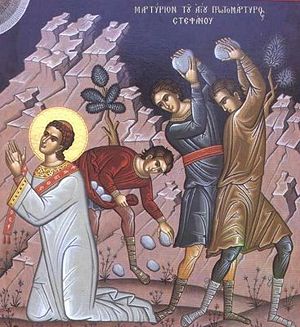
Saint Stephen - the martyr


Stephen shows that the "impossible ethic" of enemy love is indeed possible, though costly One need not be divine to do what Jesus did. Jesus tells us: "The one who believes in me will also do the works that I do and, in fact, will do greater works than these, because I am going to the Father."...Image result for saint stephen martyrdom
T S. Eliot’s Murder in the Cathedral dramatizes the martyrdom of Thomas Becket, archbishop of Canterbury, in 1170. The story builds to the final moments when Becket is pulled inside the cathedral by three priests trying to save him from the king’s forces. They bar the door for safety, but Thomas, with a boldness befitting Stephen himself demands:
Unbar the doors! throw open the doors!
I will not have the house of prayer, the church of Christ,
The sanctuary, turned into a fortress..
The church shall be open, even to our enemies.
We are not here to triumph by fighting, by stratagem, or by resistance,
Not to fight with beasts as men. We have fought the beast
And have conquered. We have only to conquer
Now, by suffering. This is the easier victory.
Now is the triumph of the Cross, now
Open the door! I command it. OPEN THE DOOR!

Like Stephen and like Jesus, Thomas went to his death opposing the forces of evil not with power but with faithfulness. Though we are tempted to hide behind barricades, guns and bombs, the stories of the martyrs remind us of the one who overcame evil not by defeating the enemy but by loving the enemy and thus defeating death itself.

http://www.religion-online.org/showarticle.asp?title=2243

Monday, May 12, 2014

Do not let your hearts be troubled

It is not surprising that the writer of Psalm 31 pleaded with God “Do not ever let me be put to shame.” It is humiliating, shameful and painfully degrading to be shamed. God of Love doesn't treat us like that. Bullies often do, or at least try, to shame others! There are many victims of bullies in our families, communities, schools and workplaces who would plead for God to deliver and speedily rescue them and keep them safe from such treatment.
Much of our Christian culture is based on guilt rather than shame and much of the Church’s culture is based on relieving guilt. But shame plays a much greater part in our societies than we may acknowledge.
Guilt says, “I recognise I have done something wrong, something bad.” Feelings of guilt are relieved by forgiveness, atonement and penance; God’s forgiveness and that of others and our-self. Shame says, “There is something fundamentally wrong with me. The concept of original sin links into shame.
The gospel reading is frequently used at funerals to comfort the bereaved beginning as it does with Jesus saying, “Do not let your hearts be troubled”. This could be another place in our Scripture where the message has been distorted by the insertion of chapters and verses. They place artificial divisions in the story.  The last verse in chapter 13, and so in the verse immediately before our Gospel reading today Jesus said to Peter, “Very truly I tell you, before the cock crows, you will have denied me three times.”
Peter had been proud to think that he was willing to lay down his life for Jesus. His response to the sound of the cock crowing was probably shame. He would have felt that he had let himself and Jesus down.  Jesus’ remark, “Do not let your hearts be troubled. Believe in God and believe also in me,” were possibly directed at comforting and reassuring Peter.
The writer of the epistle was reassuring all who had known the shame of rejection. He was encouraging and inviting them to find out for themselves that God is good and welcoming, that they were precious in God’s sight. Perhaps we could change from assuring people that their sins are forgiven and encourage people to know that they are made in the image of God, that God does not shame us.

Don’t let your hearts be troubled and don’t let them be afraid. God has plenty of room for us all!
Rev Julianne Parker
see sermon section for full sermon

an answer to Thomas

Thomas’ heart is troubled.  He’s worried and concerned about all this talk of Jesus going away.  So he asked that fateful question, “How can we know the way?”  Jesus’ statement about being the way, the truth, and the life is a response to a question by Christians, and Jesus’ answer is directed to Christians and is about Christians. Of course, Jesus’ followers wouldn’t have called themselves to “Christians” yet; but, as we learn in the book of Acts, “The Way” was one of the earliest names for Christianity.
Part of what Jesus was doing was offering comfort to Thomas: “Don’t worry, Thomas.  You know me. When I’m gone, just continue to ‘do the works that I do.’ Follow the path I have set forth with my life, and you’ll be following the way.”  So perhaps I wasn’t so wrong all those years ago to find comfort in John 14. But Jesus’ instruction doesn’t end there.  Included in Jesus’ pastoral assurance is the challenge to keep on following the way of Jesus even when it’s difficult.  The best summation I’ve seen of this perspective is by the pastor, writer, and spiritual director Eugene Peterson.  Peterson encapsulates Jesus’ point in John 14 by saying, “Only when we do the Jesus truth in the Jesus way do we get the Jesus life.” Isolating only the so-called “Jesus truth” yields a disembodied orthodoxy: all the right words with no behavior to make the words believable.  More important is the “Jesus Way” of loving God and loving neighbor.
http://www.patheos.com/blogs/carlgregg/2011/05/lectionary-commentary-%E2%80%9Ca-progressive-christian-reading-of-john-146%E2%80%9D-for-sunday-may-22-2011/

A bit of a challenge

"When my daughter tells me I’m the best daddy in the world, and there can be no other father like me, she is speaking the truth, for this comes out of her experience. She is honest about it; she knows no other person in the role of her father. But of course it is not true in another sense. For one thing, I myself know friends who, I think, are better fathers than I am. Even more importantly, one should be aware that in the next house there is another little girl who also thinks her daddy is the best father in the world. And she too is right. In fact as the level of the way the two children relate to their two fathers, no one can compare the truth content of the statements of the two girls. For here we are not dealing with the absolute truths, but with the language of faith and love. …
The language of the Bible is also the language of faith….The problem begins when we take these confessions in the language of faith and love and turn them into absolute truths. It becomes much more serious when we turn them into truths on the basis of which we begin to measure the truth or otherwise of other faith claims. My daughter cannot say to her little friend in the next house that there is no way she can have the best father, for the best one is right there in her house. If she does, we’ll have to dismiss it as child-talk!"
Christian theologian Wesley Ariarajah
from http://www.patheos.com/blogs/carlgregg/2011/05/lectionary-commentary-%E2%80%9Ca-progressive-christian-reading-of-john-146%E2%80%9D-for-sunday-may-22-2011/

the Way, the Truth and the Life

"Thomas is the first to make a statement and then ask the question that is our question: How can we know the way?
Jesus' response to this question is one that has caused enormous suffering and harm through the centuries.
But I think we have not read his response for the plain statement of truth that it is. Jesus first says:
I am the way, and the truth, and the life
And then he says:
No one comes to the Father, except through me
Now, if we simply substitute for the "me" in the second statement with who Jesus says "me" is - the "I am" in the first statement, we get:
No one comes to the Father, except through the way, the truth, and the life.
That statement, I think, is NOT grounds for slaughtering non-believers in Jesus, or forced baptisms, or worrying that non-believers have been condemned to everlasting damnation. It is, I think, a plain statement of the simple truth that the life to come will be a way of truth and life - and thank God for that. And, since Jesus has said that he will come and take us to himself, we can trust that we will not be abandoned and left on our own to find this impossible-for-us-to-be-nothing-but-truth-and-life way."
http://www.holytextures.com/2011/04/john-14-1-14-year-a-easter-5-sermon.html

We thank God for you

Haiku responding to 1 Thes 1:1-10 Paul and his comrades send greetings to the church in Thessalonika. Grace to you, and peace,...